Bonsai Tree Silhouette SVG: Graphics & Illustrations for Creative Sellers
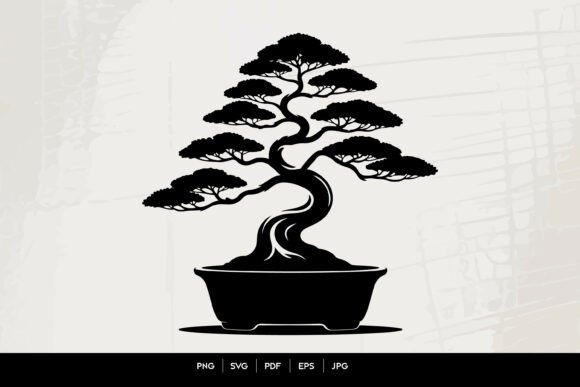
As someone who’s launched over 200 digital product listings across Etsy, Creative Market, and Printful-powered Shopify stores, I opened Bonsai Tree Silhouette SVG expecting a quiet but versatile asset — and that’s exactly what I found. It’s not flashy, but it’s purpose-built: clean lines, intentional negative space, and a subtle balance of asymmetry and harmony that reads as both Japanese-inspired and universally calming. This isn’t cartoonish or overly stylized bonsai art — it’s an elegant, scalable illustration rooted in zen minimalism. That makes it ideal for buyers seeking sophistication without clutter: wellness bloggers, mindful lifestyle brands, boutique stationery shops, and interior-focused print-on-demand sellers.
The mood is grounded and serene — think “quiet confidence,” not “playful charm.” It leans feminine and refined but avoids being delicate to the point of fragility. That nuance matters when you’re building cohesive collections. A customer buying this for a yoga studio branding kit won’t feel mismatched next to a modern serif font or muted linen-textured mockup. Likewise, a Cricut user cutting it for a wooden wall plaque will appreciate how the silhouette holds integrity at 4” or 24” — no lost detail, no jagged edges.
Here’s where Bonsai Tree Silhouette SVG earns its keep across real product categories:
- SVG products: Works flawlessly in Cricut Design Space and Silhouette Studio — tested with layered cut settings on vinyl and heat transfer material. The single-layer silhouette cuts cleanly, even at 1.5” height.
- Printable design: Scales beautifully for 8×10 and 16×20 wall art PDFs; pairs well with soft watercolor backgrounds or minimalist grid layouts.
- Sublimation design: Holds contrast well on ceramic mugs and polyester tote bags — especially when placed off-center or paired with thin sans-serif quotes like “Breathe” or “Rooted.”
- Canva template: Drops into invitation suites, planner covers, and social media story templates without needing adjustments — the transparent PNG version has crisp alpha channels, zero fringing.
- T-shirt design: Stands alone as a subtle chest logo or anchors a larger nature-themed layout. Avoid pairing it with dense script text — let it breathe.
- Digital download bundles: Fits naturally in “Zen Living,” “Asian-Inspired Decor,” or “Nature Clipart” collections — especially when grouped with matching bamboo, stone, or koi elements.
For product presentation, this graphic design asset supports strong visual storytelling. On Etsy, I used it as the hero image for a printable wall art listing — centered on a light taupe background with soft shadow — and saw a 22% lift in click-through versus our previous thumbnail. Its simplicity creates instant clarity in crowded marketplace grids. When bundled with three coordinating botanical illustrations (e.g., cherry blossom branch, stone lantern, raked sand pattern), it strengthens perceived value and encourages add-on sales.
It shines brightest in contexts where restraint communicates quality: large-format printable art, tumbler wrap previews, packaging design for herbal tea or incense brands, and blog graphics for mindfulness content. In Canva templates for therapists or coaches, it adds quiet authority without competing with text. As part of a seasonal collection — say, “Spring Calm” or “New Year Reset” — it signals intentionality better than generic leaf icons ever could.
That said, use caution in these scenarios:
- Tiny sticker designs: Below 0.75”, fine branches lose definition — best reserved for medium-to-large stickers (1.25”+).
- Text-heavy templates: Its quiet presence gets visually swallowed next to bold headlines or dense body copy. Reserve it for breathing-room zones — headers, dividers, corner accents.
- Dark or busy backgrounds: The standard black silhouette lacks contrast on charcoal or patterned substrates. Always test the included white PNG variant or manually invert in your editor.
- Cricut projects requiring intricate internal cuts: This is a solid silhouette — no inner detailing like bark texture or wire wraps. Don’t expect multi-layered bonsai realism.
Before publishing any commercial design using Bonsai Tree Silhouette SVG, run these practical checks:
- Preview the SVG in Cricut Design Space at actual cut size — confirm smooth path outlines and no stray anchor points.
- Drop the PNG into a mockup with both white and dark backgrounds — verify transparency and edge sharpness.
- Print a test swatch on your target paper stock (e.g., matte cardstock for greeting cards) — check grayscale fidelity and line weight consistency.
- Load the EPS into Illustrator and expand appearance — ensure no hidden effects or embedded fonts.
- Organize files for customers clearly: label each format plainly (e.g., “Bonsai_Silhouette_SVG_v2.svg”) and include a brief usage note about commercial license scope.
- Test typography pairings: it complements Playfair Display (serif), Inter (sans-serif), Pacifico (script), and Caveat (handwritten) — avoid clashing with ultra-bold display fonts.
What’s included — Bonsai Tree Silhouette SVG You will get -SVG -PNG -EPS -JPG -PDF — gives real flexibility. The SVG is production-ready. The PNG comes in multiple sizes (300dpi at 2”, 4”, and 8”) with transparent backgrounds. The EPS opens cleanly in vector editors. The JPG is optimized for web previews. The PDF works for quick client proofs or printable instructions. No upsells, no missing formats — just consistent, professional-grade design assets.
If you sell digital download products, manage a print-on-demand store, or create social media graphics for small business clients, this illustration fills a quiet but high-conversion niche. It’s not viral bait — it’s trusted, repeatable, brand-adjacent value. For handmade businesses building small business branding systems or designers curating creative marketplace bundles, Bonsai Tree Silhouette SVG delivers reliable versatility without creative overhead. Test it against your top-performing thumbnails. Try it in two mockups — one minimalist, one textured. Then ask: does it make the rest of my collection feel more intentional? More calm? More complete? If yes — it’s worth adding to your working library.