WiFi QR Code Sign File 223: Laser Cutting Meets Other Home Decor
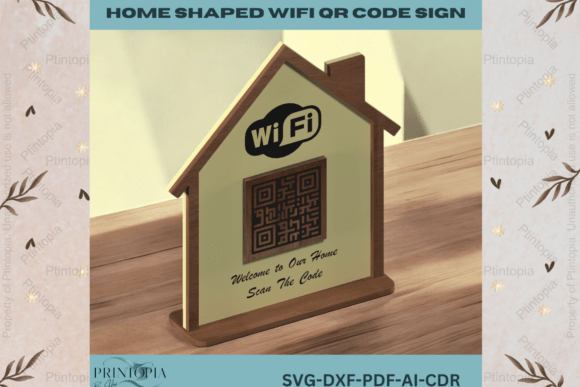
As a graphic designer who’s built brand identities for boutique Airbnb hosts, handmade candle makers, and local wedding planners, I opened WiFi QR Code Sign File 223 expecting another generic vector—what I found was a surprisingly cohesive, mood-driven design asset. It’s not just a QR code in a house shape; it’s a quiet piece of visual hospitality. The silhouette is clean but warm—rounded roof lines, subtle door detailing, and balanced negative space around the QR matrix. It reads as “handmade business” at first glance, not corporate tech. That’s rare—and valuable.
A Design Asset That Sets the Tone Before the First Click
This isn’t background filler. WiFi QR Code Sign File 223 carries emotional weight: welcome, ease, approachability. I recently used it in a pitch for a coastal cottage rental brand—part of a larger creative design system that included linen-textured stationery, soft serif typography, and muted sage-and-cream palettes. Placed beside a handwritten “Welcome to Seabreeze Cottage” header on a digital welcome guide, it anchored the experience with tangible warmth. Guests don’t scan a utility—they scan an invitation.
Where It Shines in Real Client Work
WiFi QR Code Sign File 223 excels where human-centered design meets functional clarity:
- Product mockups for Etsy sellers launching smart home accessories or artisanal guest amenities—especially when layered over natural wood, linen, or ceramic textures.
- Packaging design for small-batch soap or tea brands offering “connect & unwind” experiences—the house shape subtly reinforces “home,” while the QR delivers WiFi credentials or brewing instructions.
- Social media graphics for Instagram Reels or Pinterest pins promoting “stress-free hosting”—paired with minimalist copy like “Your password? Already shared.”
- Cricut projects and laser cutting applications: the file scales cleanly to 6”, 12”, or wall-sized formats without jagged edges—ideal for wooden signs, acrylic table tents, or engraved coasters.
- Printable design collections sold on Creative Market: bundled with matching welcome notes, luggage tags, and digital check-in cards.
Where to Use It With Intention (Not Assumption)
This asset has limits—and recognizing them is part of professional judgment. Avoid dropping WiFi QR Code Sign File 223 into:
- Small sizes (<50px wide): The QR matrix loses scannability; the house outline becomes indistinct. Always test at intended usage scale—especially for email footers or app icons.
- Crowded layouts: Its charm lies in breathing room. Next to dense text blocks or overlapping illustrations, it competes instead of complements.
- Minimalist corporate branding: If your client’s identity runs on strict grid systems, monochrome palettes, and geometric austerity, this leans too friendly—opt for a flat, sans-serif QR badge instead.
- Low-contrast backgrounds: A light-gray house on off-white paper fails both hierarchy and accessibility. Always preview on actual substrates—not just screen.
Designer Notes You’ll Actually Use
Before clearing WiFi QR Code Sign File 223 for a client project, I run these checks:
- Test black-and-white output: Does the QR remain scannable when converted to grayscale? Does the house shape retain definition without color cues?
- Check contrast ratios on both light and dark backgrounds using a tool like WebAIM Contrast Checker—critical for ADA-compliant printables and web design.
- Preview at real-world sizes: Zoom out to 25% in Illustrator—does the detail hold up on a 24” poster? Zoom in to 400%—are anchor points smooth, or does the SVG show distortion?
- Drop it onto 3–4 product mockups: A wooden door hanger, a ceramic mug, a linen tote bag. Does it feel native—or pasted on?
- Verify file formats: Confirm the package includes editable SVG (for vector scaling), high-res PNG with alpha transparency (for Canva templates or social overlays), and optionally EPS for legacy print workflows.
- Font pairing test: Try it beside your client’s primary typeface—does it harmonize with their script font (e.g., for wedding rentals) or contrast effectively against a sturdy sans serif (e.g., for modern co-living spaces)?
- Licensing audit: Is the commercial license explicit? Does it cover sublimation design, POD platforms like Printful, and resale in digital bundles? Never assume.
Why It Works Beyond the Obvious
In a sea of generic QR assets, WiFi QR Code Sign File 223 earns its place by solving two problems at once: functional access and emotional resonance. It elevates a transactional moment—connecting to WiFi—into a branded gesture. For a handmade business, that’s trust-building. For a boutique hotel’s digital guest journey, it’s consistency. For a Cricut user building custom signage, it’s time saved without sacrificing craft.
It’s also a reminder that even utilitarian elements—like network access—deserve thoughtful visual treatment. When your client’s audience scans that house-shaped code, they’re not just joining a network. They’re stepping into a story you helped design.
Final Verdict for Professional Use
WiFi QR Code Sign File 223 is a strong graphic design asset for designers working in Other Home Decor, lifestyle branding, and experiential marketing. It supports small business branding authentically, performs across print-on-demand, sublimation design, and social media graphics, and integrates cleanly into broader brand identity systems—provided you honor its stylistic voice and technical boundaries. It’s not universal, but where it fits? It feels intentional, human, and quietly brilliant.