Woodland Ink Illustration Bundle: Vintage Forest Graphics & Illustrations
As a brand designer who’s built visual identities for over a dozen small businesses—and as a content marketer who’s launched campaigns across Pinterest, Instagram, and email—I opened the Woodland Ink Illustration Bundle expecting charm. What I found was something more strategic: a cohesive, emotionally resonant set of vintage forest illustrations that land with quiet confidence—not nostalgia for its own sake, but nostalgia as a tool for clarity, warmth, and differentiation.
First Impression: Mood, Tone, and Audience Alignment
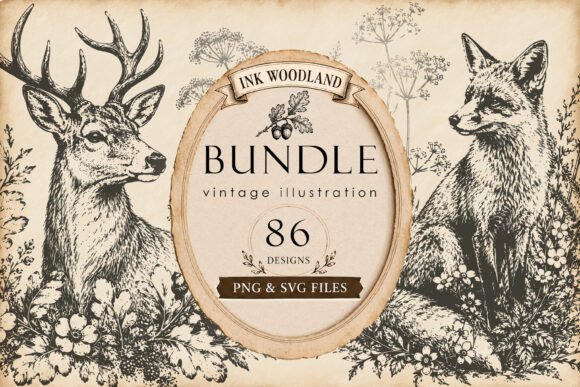
The moment you unarchive the files, you’re met with inked foxes, delicate ferns, hand-drawn owls, and winding ivy—all rendered in rich black-and-white line work with subtle texture overlays. There’s no forced whimsy or cartoonish exaggeration. Instead, the Woodland Ink Illustration Bundle evokes a sense of thoughtful craftsmanship—like a well-worn botanical field guide or a letterpress-printed apothecary label. It reads as handmade but intentional, rustic but refined.
This tone makes it ideal for brands rooted in wellness, slow living, nature-based education, herbal products, artisanal goods, or mindful parenting. It supports audience trust not by shouting “premium,” but by signaling care in detail—something your ideal customer notices before they even read your headline.
Where It Shines in Real Marketing Workflows
I recently used the Woodland Ink Illustration Bundle to refresh the visual system for a seasonal launch: a small-batch herbal tea line releasing a limited “Forest Bloom” collection. Here’s how it performed across key touchpoints:
- Social media graphics: Paired with soft sage and cream backgrounds, the illustrations created instant cohesion across Instagram carousels and Pinterest pins—no need to over-design. The consistent linework reinforced brand identity without repeating the same image.
- Packaging design: Used as subtle border accents on tea box inserts and label corners, the illustrations added tactile sophistication without overwhelming product information.
- Email banners & lead magnets: A single inked mushroom illustration anchored a “Free Foraging Guide” PDF—elevating perceived value while keeping focus on the offer.
- Canva templates: Converted select SVG designs into editable Canva elements for team use—enabling non-designers to maintain visual consistency across blog graphics and promo posts.
- Digital ads: Scaled cleanly for Facebook and Pinterest ad headers at 1080×1080, especially when placed against muted gradients (not pure white). The contrast held up beautifully.
It also worked seamlessly in editorial design—think blog headers for nature writing, newsletter dividers, and printable content bundles for online coaches teaching forest therapy or seasonal mindfulness.
Strategic Brand Benefits—Beyond Aesthetics
This isn’t just another clipart pack. As a graphic design asset, the Woodland Ink Illustration Bundle delivers measurable marketing advantages:
- Stronger first impression: Its distinct style cuts through algorithmic noise—especially on Pinterest and Instagram feeds saturated with flat vector icons.
- Clearer visual hierarchy: Because each illustration has breathing room and strong negative space, text overlays remain legible—even in mobile-first layouts.
- Better product presentation: When layered behind product photography (via overlay blend modes), it adds depth without competing with the hero item.
- Emotional connection: The antique-inspired linework taps into subconscious associations with authenticity, tradition, and groundedness—key drivers for lifestyle and wellness audiences.
- Professional branding at scale: With both SVG and high-res PNG options, it adapts from tiny favicon accents to large-format posters—no pixelation, no licensing ambiguity.
Best Use Cases: Hero Graphics, Not Background Noise
The Woodland Ink Illustration Bundle excels where intentionality matters most:
- Hero graphics for seasonal campaign landing pages
- Branded Canva templates for social teams
- Decorative borders and dividers in digital product workbooks
- Subtle packaging accents—especially on kraft paper or matte labels
- Editorial illustrations for newsletters, blogs, and print zines
- Sticker sheets and merch for creative entrepreneurs
Where to Proceed with Care
Like any strong design bundle, its power lies in context. Avoid using it in:
- Formal corporate branding (e.g., B2B SaaS dashboards or financial reports)
- Text-dense layouts—its organic lines can visually compete with body copy
- Small mobile buttons or app icons (details blur below 64×64px)
- Low-contrast backgrounds (e.g., light gray on off-white) where line weight disappears
- Brands built on stark minimalism—the illustrations carry gentle personality, not neutrality
Practical Designer Notes Before You Launch
Before embedding the Woodland Ink Illustration Bundle into client work or paid campaigns, run these checks:
- Test each illustration against your primary brand color palette—especially in overlay mode.
- Print a black-and-white version to verify contrast and readability in monochrome contexts (e.g., packaging stamps or press kits).
- Drop assets into real campaign mockups—not just isolated previews—to assess balance and spacing.
- Preview on mobile screens: does the focal point hold? Does fine detail vanish?
- Compare side-by-side with top competitor visuals—does it feel distinctive, not derivative?
- Pair with your brand fonts: it harmonizes beautifully with serif and script fonts, holds its own with clean sans serifs, and softens harsh display fonts—but avoid pairing with overly decorative handwritten styles that clash tonally.
- Confirm commercial license coverage—this digital product includes full rights for business use, but always verify scope before resale or white-label applications.
When leveraged intentionally—not as decoration, but as a deliberate creative design decision—the Woodland Ink Illustration Bundle becomes more than a set of illustrations. It becomes a quiet amplifier of voice, values, and visual trust. For small business branding, content marketing, and handmade product promotion, it’s not just vintage—it’s viable.